Control Library

Map every control to its obligations and risks,
with agents monitoring continuously

Agents trace each regulatory change to the controls it affects and flag gaps in coverage and design

Request a demo →
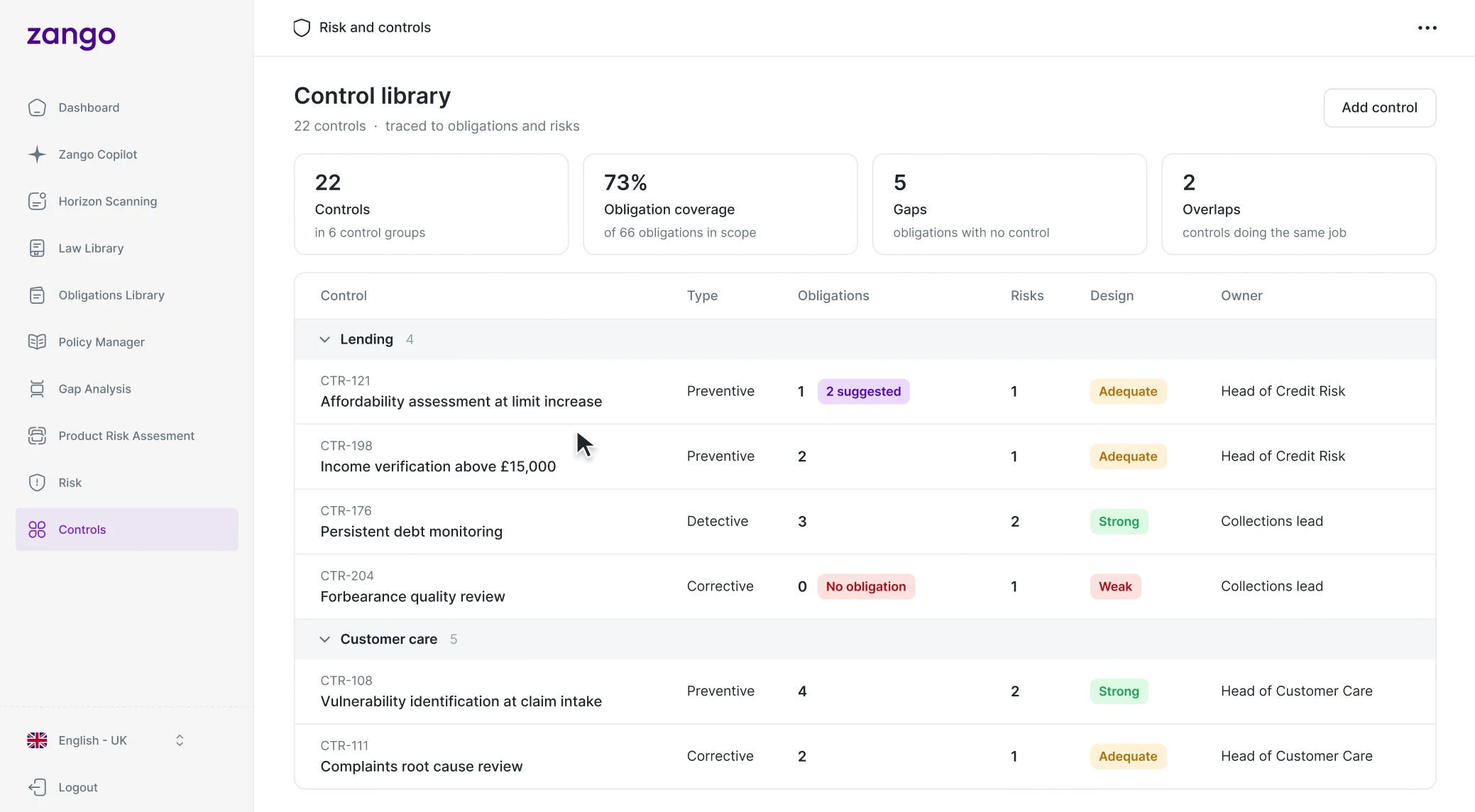
Zango Control Library: a list of controls with their type, linked obligations and design assessment

Trusted by leading financial institutions

Controls drift from the obligations they were built for
agents keep controls current with every regulatory change

Which obligations and risks does it cover?

Agents link each control to the obligations, risks and policies it serves.

Where are the gaps and overlaps?

Agents compare controls by type, obligation and risk to surface gaps, duplicates and single points of failure.

Is the control design adequate?

Agents assess each control's design against the obligation it serves and propose a rewrite where it falls short.

Who approves the change?

The control owner applies or edits the rewrite, and the change is approved through maker-checker sign-off.

Control Library list of controls, each with its design adequacy rating
Lara Reis
Lara Reis
Head of Regulatory Affairs @ novobanco
“We are thrilled with how Zango has transformed our compliance processes, saving us hundreds of hours of manual repetitive work and allowing our team to focus on strategic initiatives.”
7x
ROI by replacing consultants
70–80%
Time saved on gap analysis
Live
Every control linked to the obligations it meets

Inside Control Library

Follow a regulation through to the controls that meet it: traced to obligations, linked to risks, assessed for design and kept current.

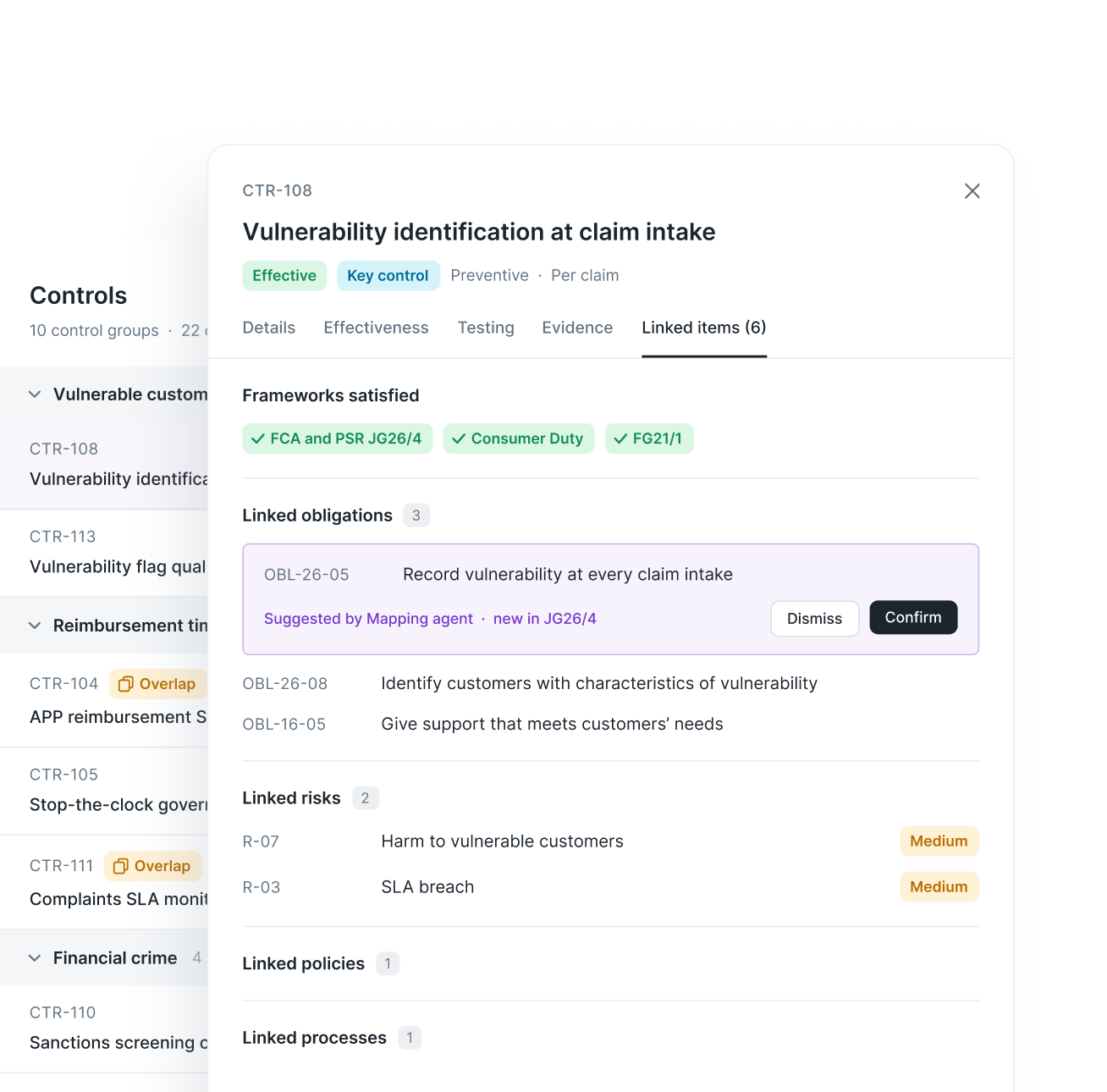
A control's linked items: the frameworks it satisfies and its linked obligations, policies and risks

Traced from regulation to control

Regulations, obligations, policies and controls sit on one linked record, so the audit trail holds when any element changes.
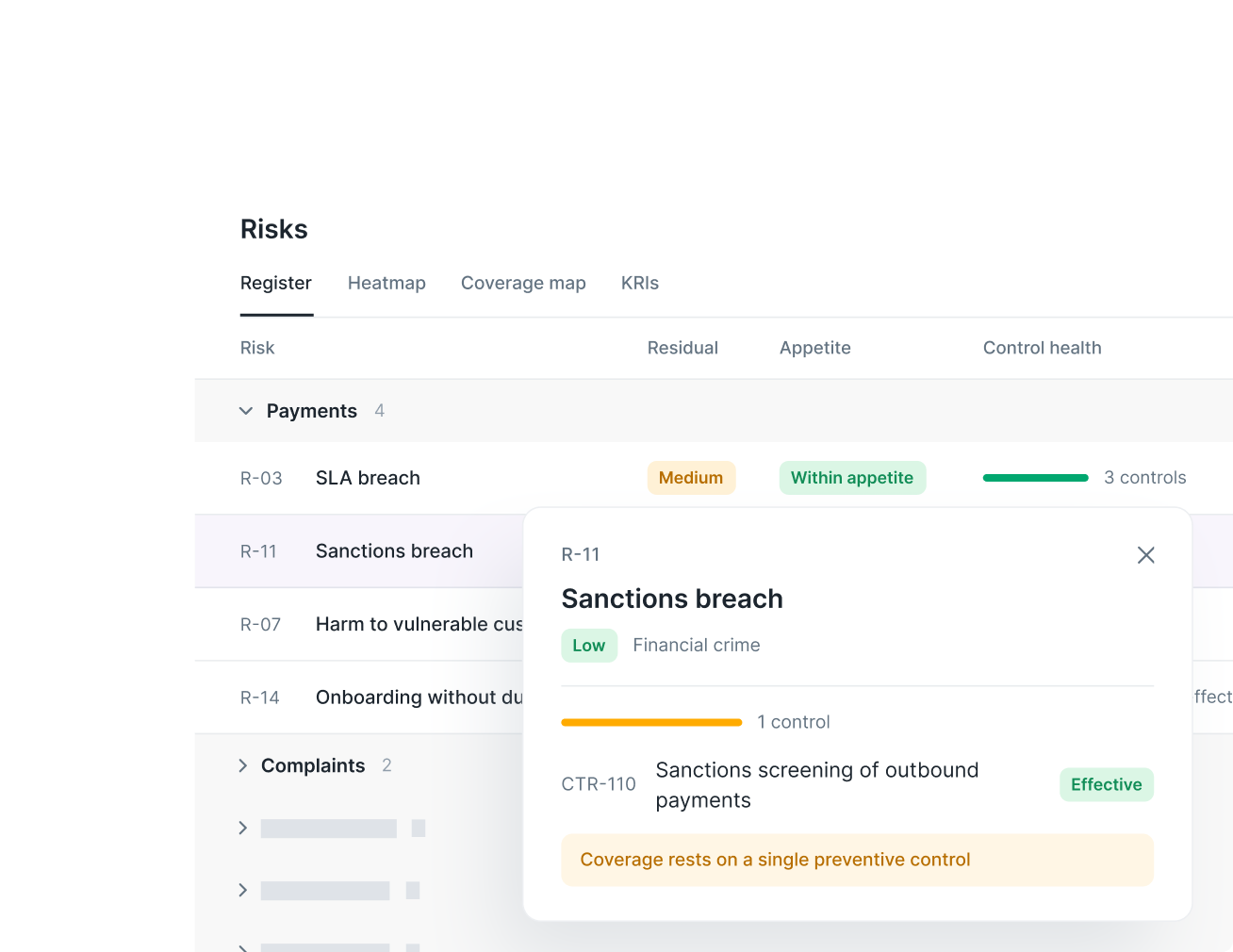
Risk register with a risk opened, showing coverage resting on a single preventive control

Mapped to the risks it mitigates

See which risks rely on which controls, and where coverage is thin or concentrated in a single control.
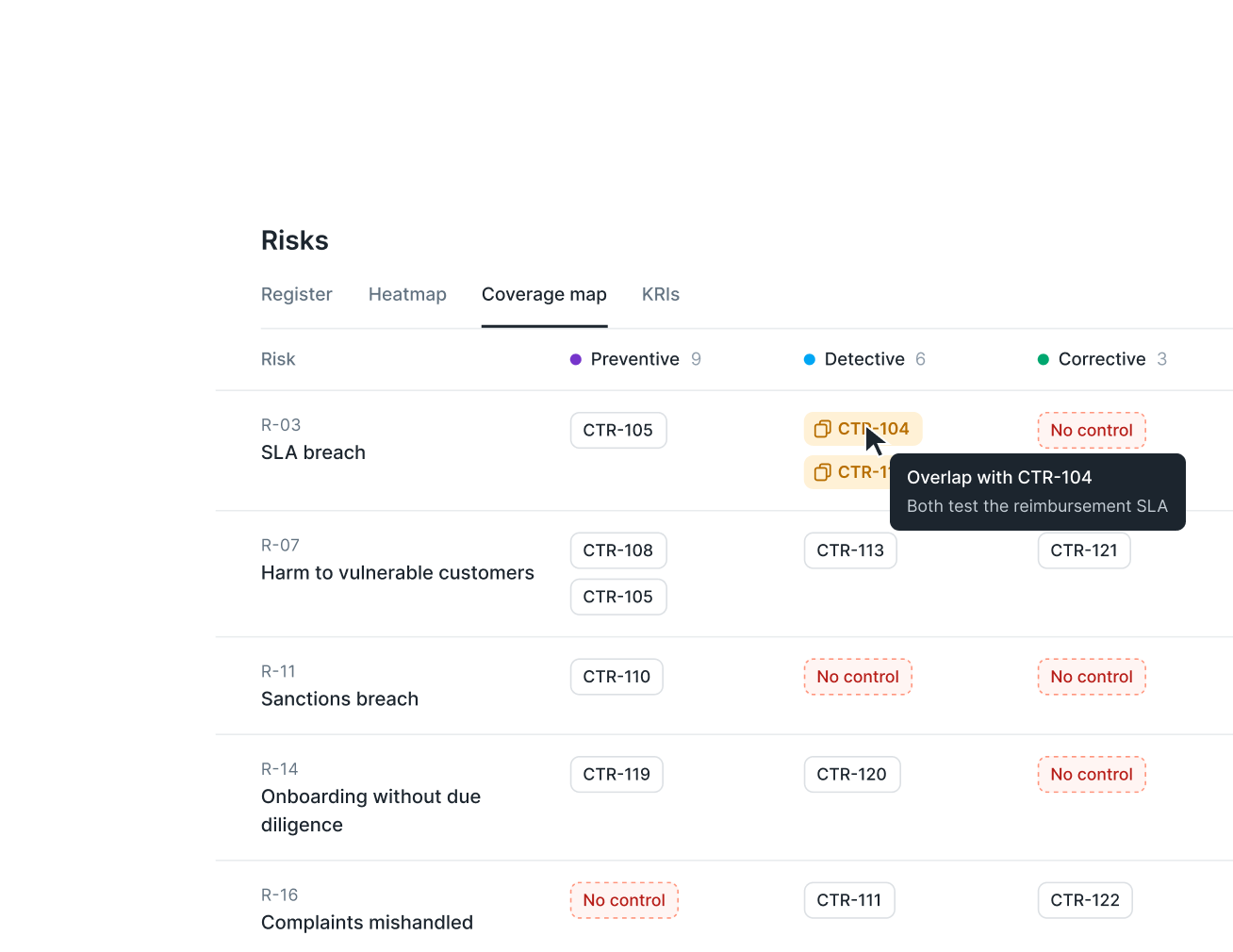
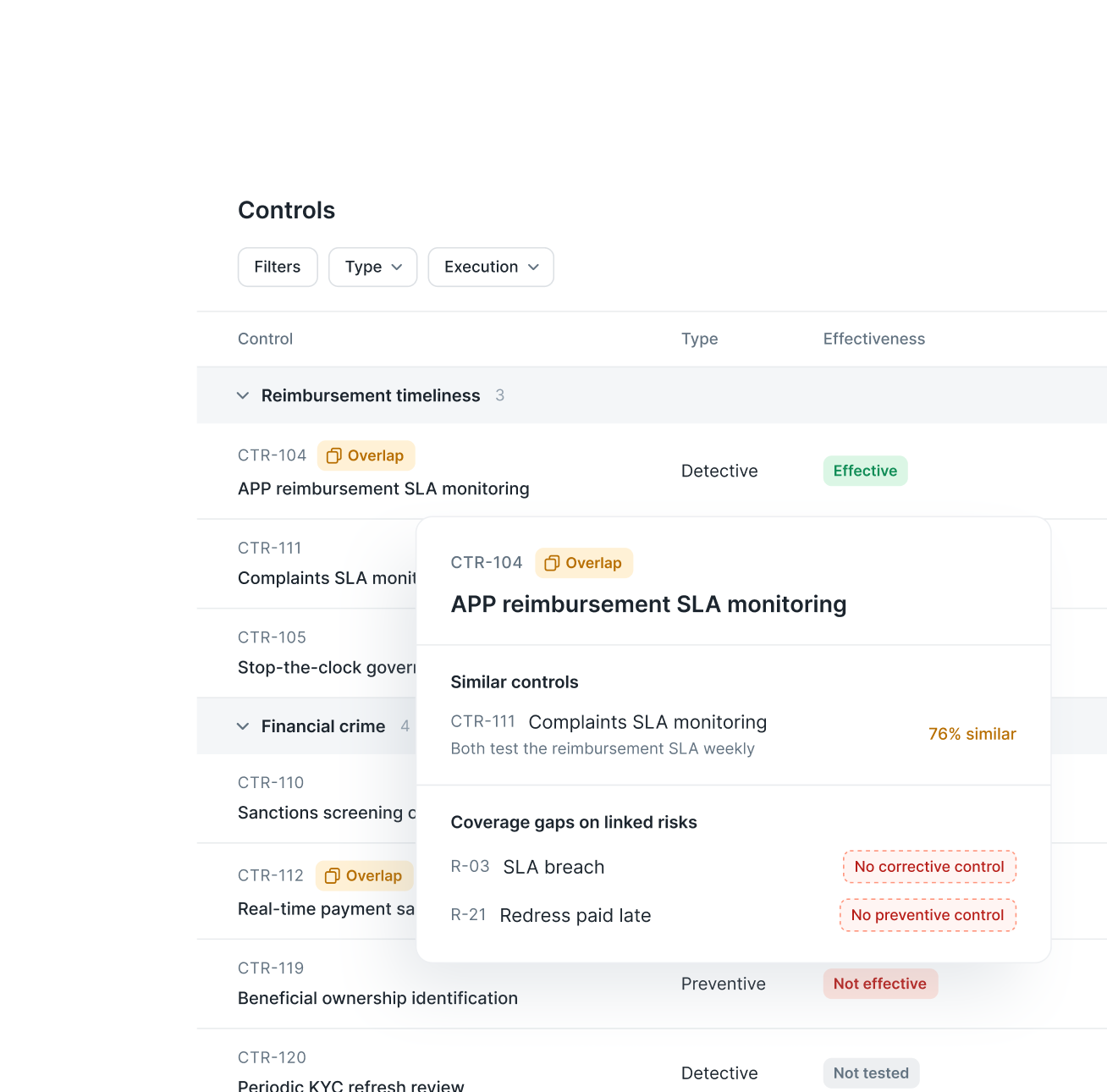
Coverage map of risks against preventive, detective and corrective controls, with gaps and an overlap flagged

Preventive, detective and corrective coverage

Test the balance of your control environment by risk, and identify overlapping or duplicated controls.

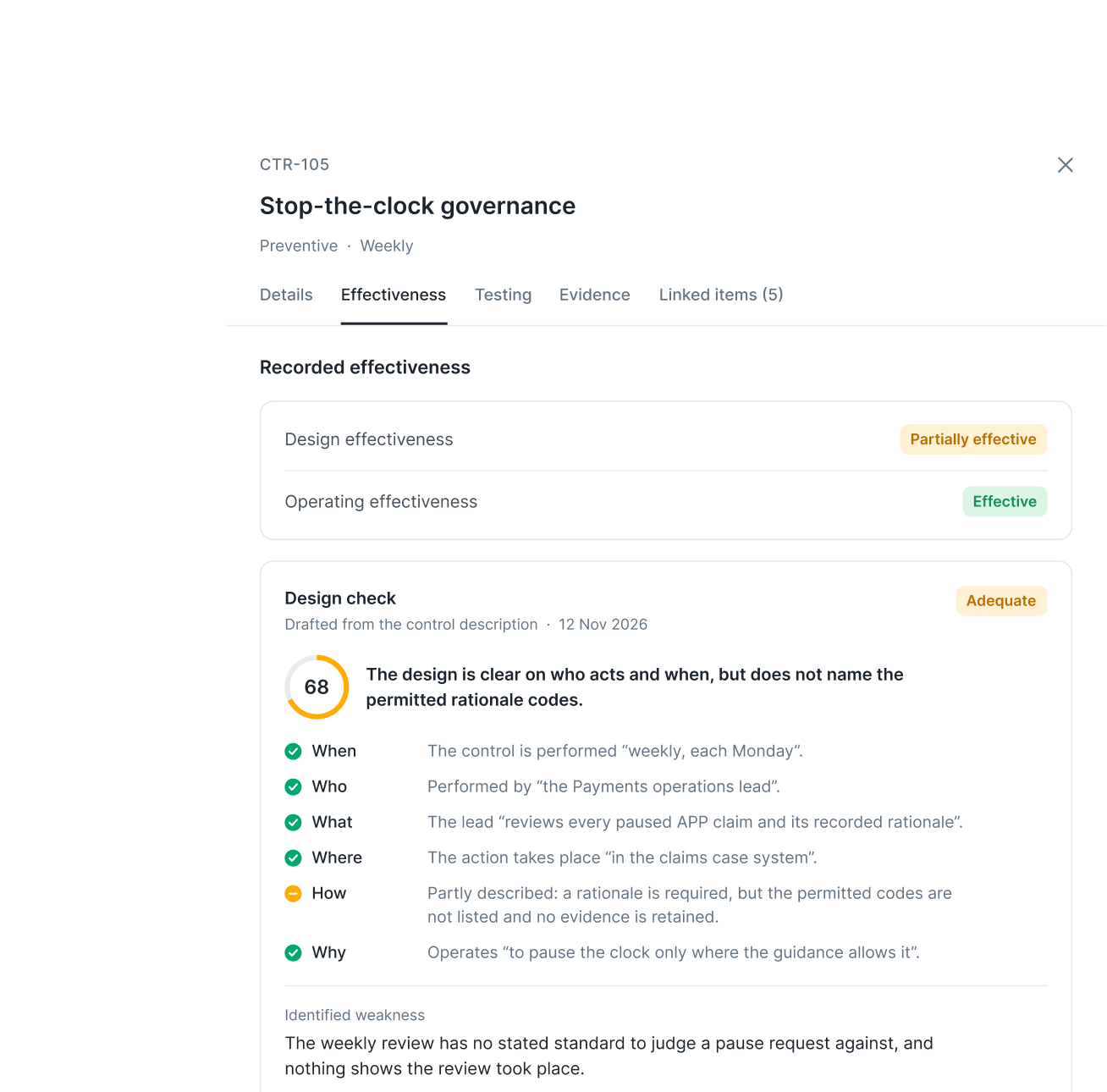
A control's design check with a score, a suggested rewrite and the options to discard or approve it

Design assessed, remediation approved

Each control is assessed for design effectiveness against the obligation it serves. Weaknesses arrive with proposed wording for the owner to approve, and the decision is recorded.
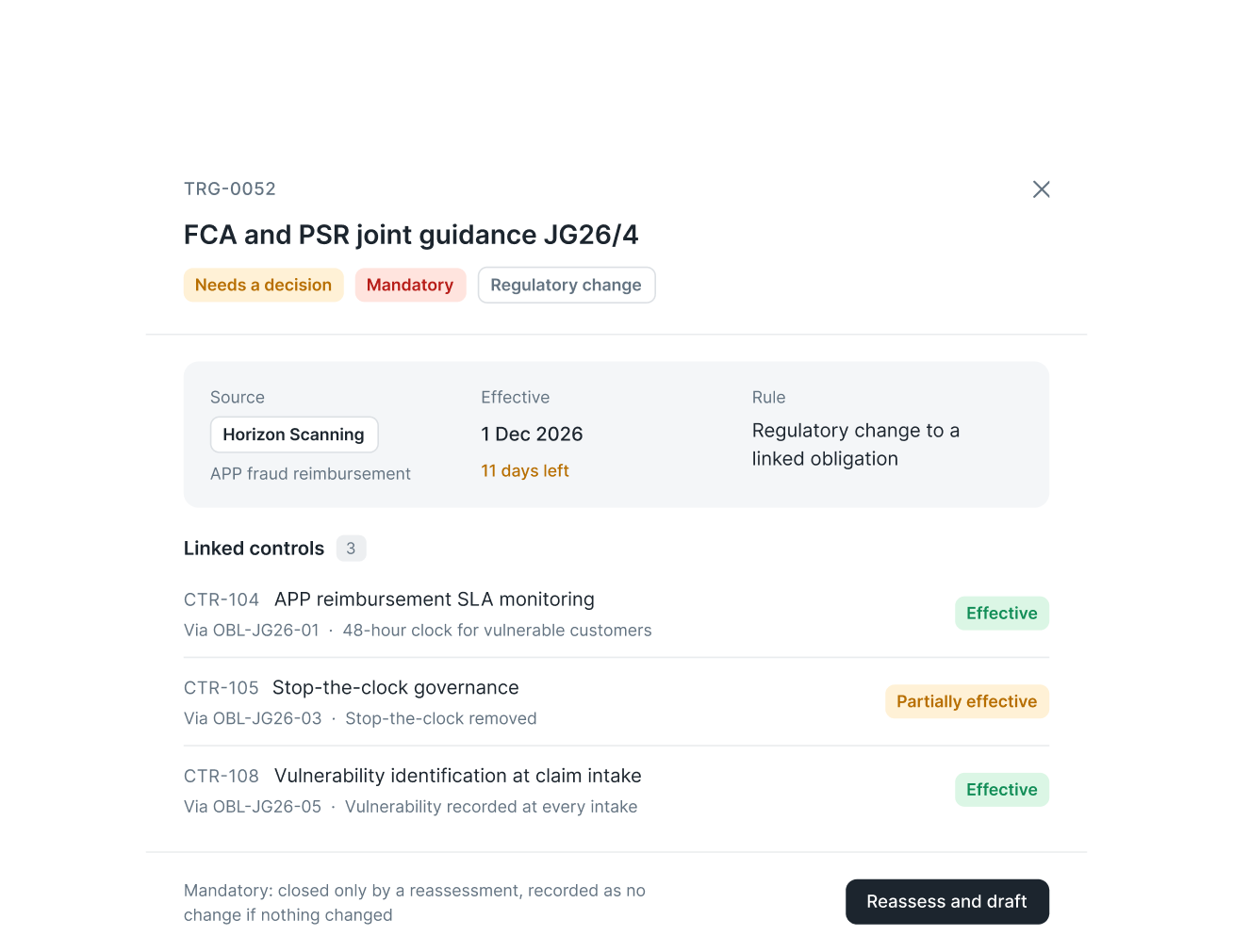
A regulatory change with its effective date and the linked controls it affects

Regulatory change traced to every control

Follow a change from the regulation to the obligations it amends and every control it affects, well before the effective date.

Controls, kept current

From new guidance to an approved control, same day

Day 0
Monitoring agent detects joint guidance JG26/4
3 controls and 2 policies found affected
Change routed to each control owner
+2 hours
Mapping agent links each control to its obligation
CTR-105 linked to OBL-JG26-03
Payments operations lead checks the links
Same day
Assessment agent reviews the design of CTR-105
One weakness found: rationale codes not named
Rewrite suggested for the owner
Sign-off
CTR-105 v2.1 approved by Chief Risk Officer
Reason for the change recorded
Next sample test scheduled for Q1 2027
Controls, kept current

From new guidance to an approved control, same day

Day 0

Agent flags the amendment and scopes it to your licences.

✦Monitoring agent Flags the amendment and scopes it to your licences.
New amendment
PRA finalises Pillar 2A review, phase 1 (PS15/26)
PRA  •  High impact  •  1 licence affected
SoP 5/15 The PRA’s methodologies for setting Pillar 2 capital
Amended Regulation
+2 hours

Agent extracts the obligations. An expert verifies each one.

✦Extraction agent Extracts the obligations. An expert verifies each one.
Obligations extracted
32 obligations, each cited to its source clause
24 new  •  8 amended
OBL-PRA-212
Hold Pillar 2A capital under the updated methodology
New
OBL-PRA-213
Apply the revised credit concentration risk approach
New
OBL-PRA-207
Recalculate the operational risk add-on
Amended
OBL-PRA-214
Update the ICAAP to reflect the Pillar 2A changes
New
OBL-PRA-209
Report Pillar 2A data in the revised templates
Amended
OBL-PRA-215
Reassess pension obligation risk under the new approach
New
26 more
Verified by Regulatory expert
Verified
Same day

Agent maps each obligation to your policies and controls, and flags the gaps.

✦Mapping agent Maps each obligation to your policies and controls, and flags the gaps.
Gap analysis ready
Obligations mapped to your policies and controls
1 gap  •  1 partial  •  4 adequate
Capital Adequacy Policy, section 3.2
Gap
ICAAP control CTL-044, quarterly add-on review
Partial
Sign-off

Your team reviews, remediates and approves. The decision stays with you.

✦Your team reviews, remediates and approves. The decision stays with you.
Awaiting approval
Gap analysis ready for sign-off
2 owners assigned  •  Evidence requested
Approve
Request changes
PO
HC
Day 0

Agent detects the guidance and finds the affected controls.

Monitoring agent

Detects the guidance and finds the affected controls.

✦Monitoring agent Detects the guidance and finds the affected controls.
New guidance
FCA and PSR joint guidance JG26/4 on APP fraud reimbursement
High impact • Effective 1 Dec 2026 • 3 controls and 2 policies affected
CTR-105 Stop-the-clock governance Stop-the-clock removed except documented first-party fraud suspicion
Affected
CTR-104 APP reimbursement SLA monitoring 48-hour clock for vulnerable customers, replacing five business days
Affected
CTR-108 Vulnerability identification at claim intake Vulnerability recorded at every intake
Affected
Routed to each owner · just now
+2 hours

Agents map the change to each control. The owner checks the links.

Mapping agent + Payments operations lead

Agents map the change to each control. The owner checks the links.

✦Mapping agent Agents map the change to each control. The owner checks the links.
Controls mapped
CTR-105 Stop-the-clock governance linked to OBL-JG26-03
Preventive • Owner confirmed
CTR-105 → OBL-JG26-03 Pause only with documented fraud suspicion
Linked
CTR-104 → OBL-JG26-01 Reimburse vulnerable customers within 48 hours
Linked
CTR-108 → OBL-JG26-02 Record vulnerability at every intake
Linked
Checked by Payments operations lead
Same day

Agent assesses design and suggests a rewrite.

Assessment agent

Assesses design and suggests a rewrite.

✦Assessment agent Assesses design and suggests a rewrite.
Design assessed
CTR-105 design adequacy: one weakness found
High confidence • 1 weakness • Rewrite suggested
Permitted rationale codes are not named The weekly review has no stated standard to review against
Weakness
Suggested rewrite
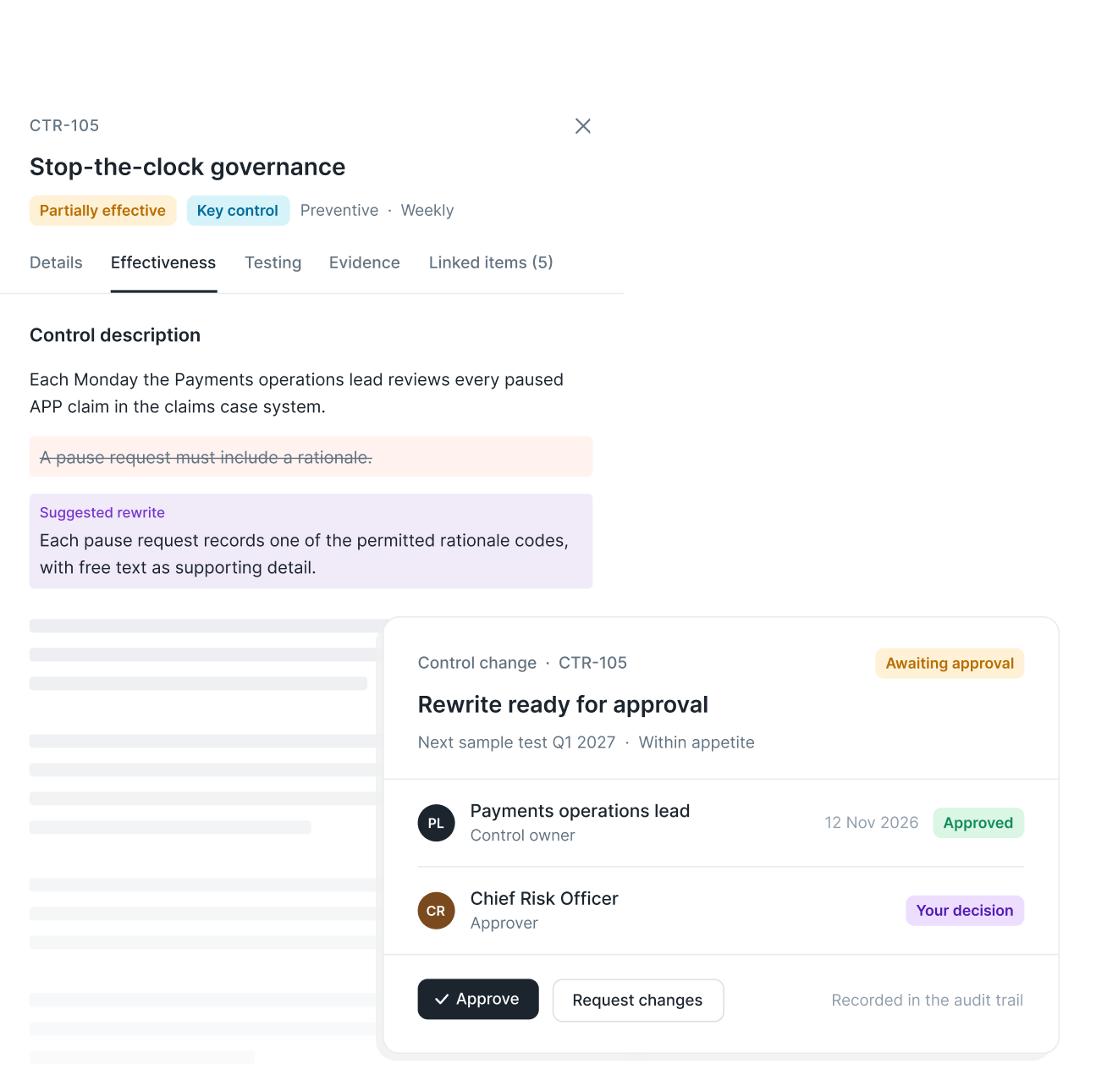
Name the permitted rationale codes and require one on every pause request, with free text as supporting detail.
Draft
Sign-off

Your approver signs off the rewrite. The decision stays with you.

Your team

Your approver signs off the rewrite. The decision stays with you.

✦Your approver signs off the rewrite. The decision stays with you.
Awaiting approval
CTR-105 rewrite ready for approval
Next sample test Q1 2027 • Within appetite
CTR-105 v2.0 → v2.1 · Reason: JG26/4, a named rationale code required on every pause
Awaiting approval
Approve
Request changes
OW
CR
CTR-105 v2.1 approved by Chief Risk Officer
Approved
Next sample test scheduled in Controls Testing for Q1 2027
Scheduled

Built for regulated financial services firms

Request a demo →

SOC 2

Security controls independently audited against the AICPA trust criteria.

ISO 27001

Certified to the international standard for information security management.

GDPR

Personal data processed in line with UK and EU GDPR.

Encryption
Data is encrypted in transit and at rest
Access control
Single sign-on and role-based permissions.
Audit trail
Every change recorded who, what and when.

Agents do the groundwork.
Your experts keep the judgement.

Every decision, sign-off and accountability stays with your team, on the record.
Speak to an expert
Research and insight

Shaping how financial services adopts AI

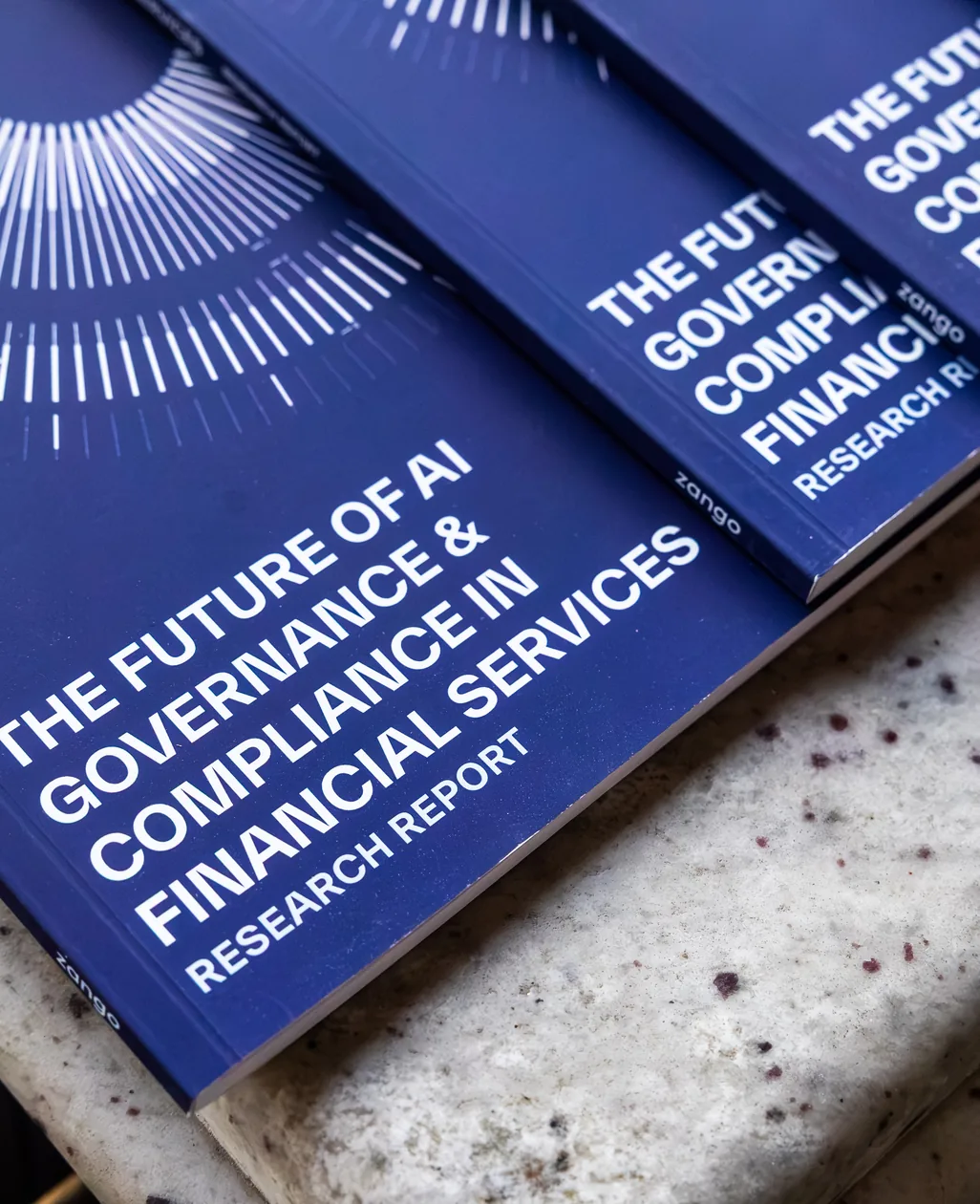
Printed copies of the future of AI governance and compliance in financial services research report
Research report

The future of AI governance and compliance in financial services

Interviews with 27 senior risk, compliance and AI governance leaders, advised by the University of Glasgow and Oxford Martin School.

Read the report →

Speaker at the Madrid Regulatory Forum hosted with IE University
Event

Madrid Regulatory Forum

The ECB, Banco de España and Spain's leading banks on governing AI at scale. Hosted with IE University.

Read the recap →

Zango's Control Library FAQs

Talk to us →

Control library software keeps every control in one place, with its owner, type and the obligations and risks it covers. Zango links each control to live regulation, so the library stays current as rules change, and every control can be traced to the obligation behind it and the risks it mitigates.

A spreadsheet control register is a snapshot that falls out of date as soon as a regulation, policy or owner changes. Zango keeps controls, obligations, risks and policies on one linked record, so a change on one side shows up on every control it affects, with the audit trail intact.

How do AI agents link a control to regulation?

Zango's agents suggest links between each control and the obligations it meets, the risks it mitigates and the policies and processes it sits in. Your team confirms each link, so every connection in the control library has an owner and a recorded reason behind it.

Design effectiveness asks whether a control, as described, would mitigate the risk it is mapped to. Operating effectiveness asks whether it works in practice, tested on a sample. In Zango, a control that fails on design is fixed before it is tested, so testing effort goes to controls built to work.

Zango compares controls by type and by the obligations and risks they cover. Overlaps and duplicates surface automatically, along with risks that rely on a single control, so you can rationalise the control environment and strengthen coverage where it is thin.

Zango's agents trace the change from the regulation to the obligations it amends, then to every control and policy it affects. Each control owner receives the change well before the effective date, with the reason and source recorded.

No. Where a control's design falls short, Zango's agents suggest a rewrite. The control owner applies or edits it, the change is approved through maker-checker sign-off, and the decision is recorded against the control.

Controls move into Zango Controls Testing with a clear design standard, and test results flow straight back into the Control Library as operating effectiveness. Each control keeps its owner, links, test history and conclusions on one record.

Yes. Zango records every link, rating, test, piece of evidence, attestation and change of owner with who, what and when. Auditors can follow the full history of any control without anyone rebuilding it by hand.

Yes. Zango is SOC 2 audited and ISO 27001 certified, processes personal data in line with UK and EU GDPR, encrypts data in transit and at rest, and supports single sign-on with role-based permissions. Every change is recorded with who, what and when.