
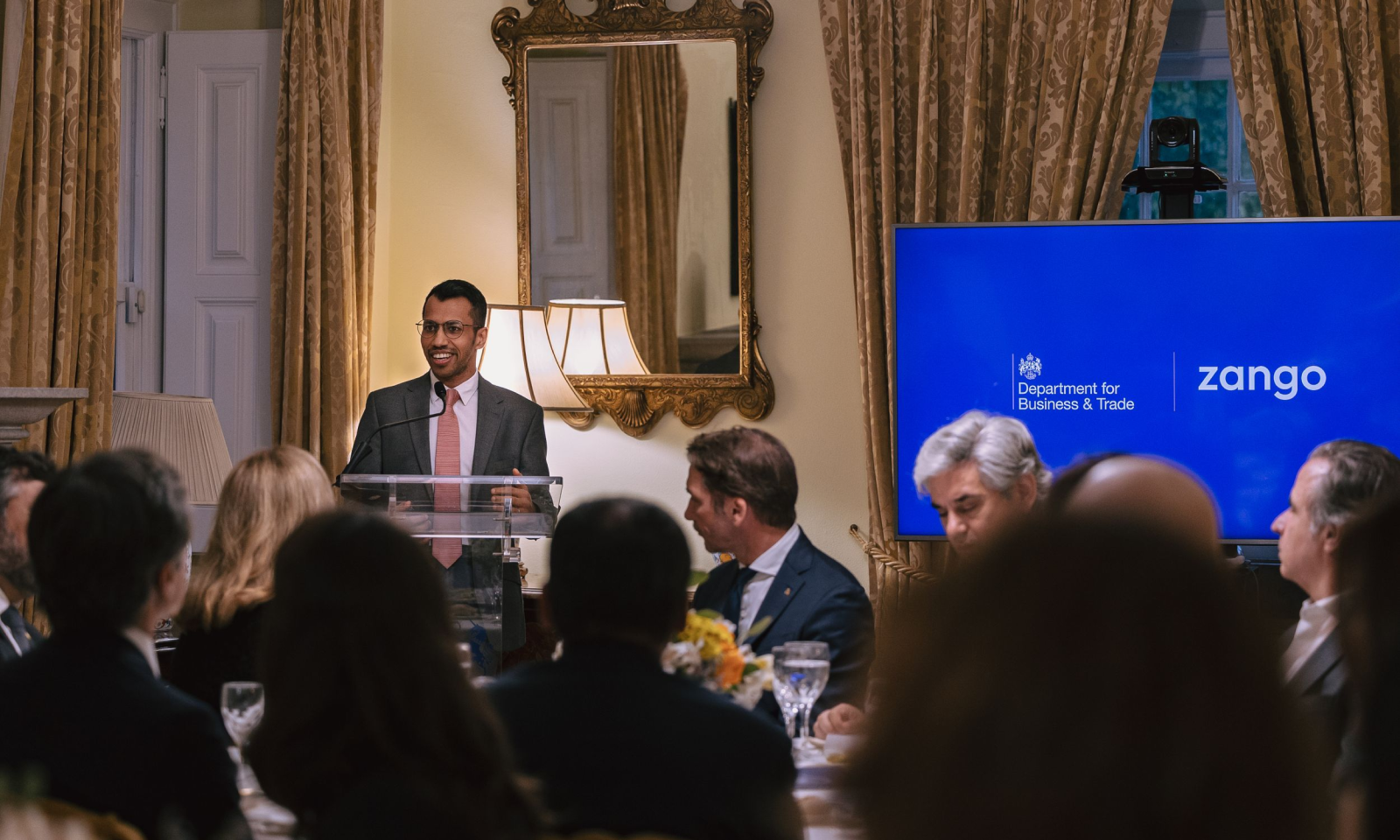
On 14 April, the British Ambassador’s Residence in Lisbon held a private dinner convened by HSM Ambassador Lisa Bandari and co-hosted with Zango AI. The event brought together senior representatives and board members from CMVM, APB, and Portugal’s leading financial institutions including Caixa Geral de Depósitos, Millenium bcp, Banco BPI, BiG, Montepio, Banco Itaú, Aegon, Banco Finantia, Fidelidade, Real Vida Seguros, Crédito Agrícola, Bankinter, Rothschild, Natixis, Lusitânia and Western Union in Portugal.
Reflecting on the importance of convening such a group, Ambassador Bandari noted:
“The challenge of our time is the responsible integration of artificial intelligence. Open conversations between regulators, institutions and technology leaders like this are essential. And I’m proud that a UK-based company like Zango AI is playing a leading role in advancing that dialogue here in Portugal.”
The discussion centred on a question increasingly at the forefront for both regulators and institutions: how to establish effective governance frameworks for AI in financial services, and whether a proactive, rather than reactive, approach is achievable.
The session was facilitated by Adolfo Mesquita Nunes, who underscored the strategic importance of how AI is implemented.
“Artificial intelligence is not neutral in its effects, it shapes how decisions are made and how reality is perceived. For that reason, its deployment must be grounded in ethics from the outset.”
Among the themes discussed, participants highlighted that Portugal has a set of characteristics that position it well to contribute meaningfully to this evolving area, including the close engagement between regulators and financial institutions, the strength of its talent base, and its ability to foster agile dialogue across stakeholders.
The discussion took place at a critical juncture. The EU AI Act has now entered into force, and European supervisory authorities are in the process of developing the technical standards that will define how AI is deployed within regulated financial activities. The frameworks established during this period are likely to have lasting implications for compliance, risk management, and supervisory practices across the region.
Adding an industry perspective, Ritesh highlighted some of the structural implications already emerging:
“Our research shows that as AI moves faster inside financial institutions, the people responsible for oversight are struggling to keep up. The teams closest to the technology are moving quickly, but the compliance and risk functions sitting behind them often don't have the tools to stay in control. Zango's work is focused specifically on that gap: building the infrastructure that lets compliance teams keep pace with the speed at which AI is being deployed across the business.”
The event forms part of Zango AI’s broader work on AI governance in financial services, including ongoing research in collaboration with academics from the University of Oxford and the University of Glasgow, policymakers, and a network of more than 25 risk and compliance executive leaders from financial institutions.
More broadly, the discussion underscored that countries that engage early in defining practical and credible governance models for AI will be better positioned to strengthen oversight, support innovation, and maintain competitiveness in an increasingly regulated environment. Portugal appears well positioned to play such a role.
.png)