




On 19 October 2026, the FCA published examples of good practice and areas for improvement in how firms deploy and govern AI. The publication is organised around three areas: Consumer Duty and consumers in vulnerable circumstances; governance and accountability; and operational resilience.
The FCA is clear that they "do not create new requirements, prescribe a single model or replace firms' responsibility for considering what is appropriate and proportionate for their own AI use cases, risks and potential impact." But its anonymised case studies give firms a useful picture of what good looks like in practice.
While the publication is an extremely useful resource, it is deliberately general and relatively high level. This leaves firms to translate the FCA's observations into operational practice, a challenge we have consistently identified through our research. For example, the FCA says firms "should be able to show that the controls they choose work in practice". But what this means in practice will depend on the specific AI use case, the risks involved and the controls put in place.
This article applies the FCA's observations to a specific use case, namely, an AI agent that carries out first-pass compliance reviews of financial promotions. Focusing on the examples most relevant to how the agent is built, governed and overseen, it examines what the FCA says, how this translates into operational controls, and the evidence that shows those controls work in practice. It does not attempt to cover every example in the publication, some of which concern broader, firm-wide governance arrangements.
The use case: AI-supported review of financial promotions
Financial promotions are a useful case study, in that they reach consumers directly, are assessed against both prescriptive rules and the broader requirement that communications are fair, clear and not misleading, and have been an area of increasing supervisory focus for the FCA.
The agent described here has been developed by Zango and is used by financial institutions in the UK and Portugal. It works as follows:
- Knowledge base: before any material is reviewed, Zango maps the regulations that apply in each jurisdiction the firm operates in to specific rules for marketing. The firm reviews these, adds its own internal rules and a library of approved claims with supporting evidence (such as the fee schedule behind a claim of "zero commission on UK shares"), sets the products and marketing channels in scope, and signs off the result;
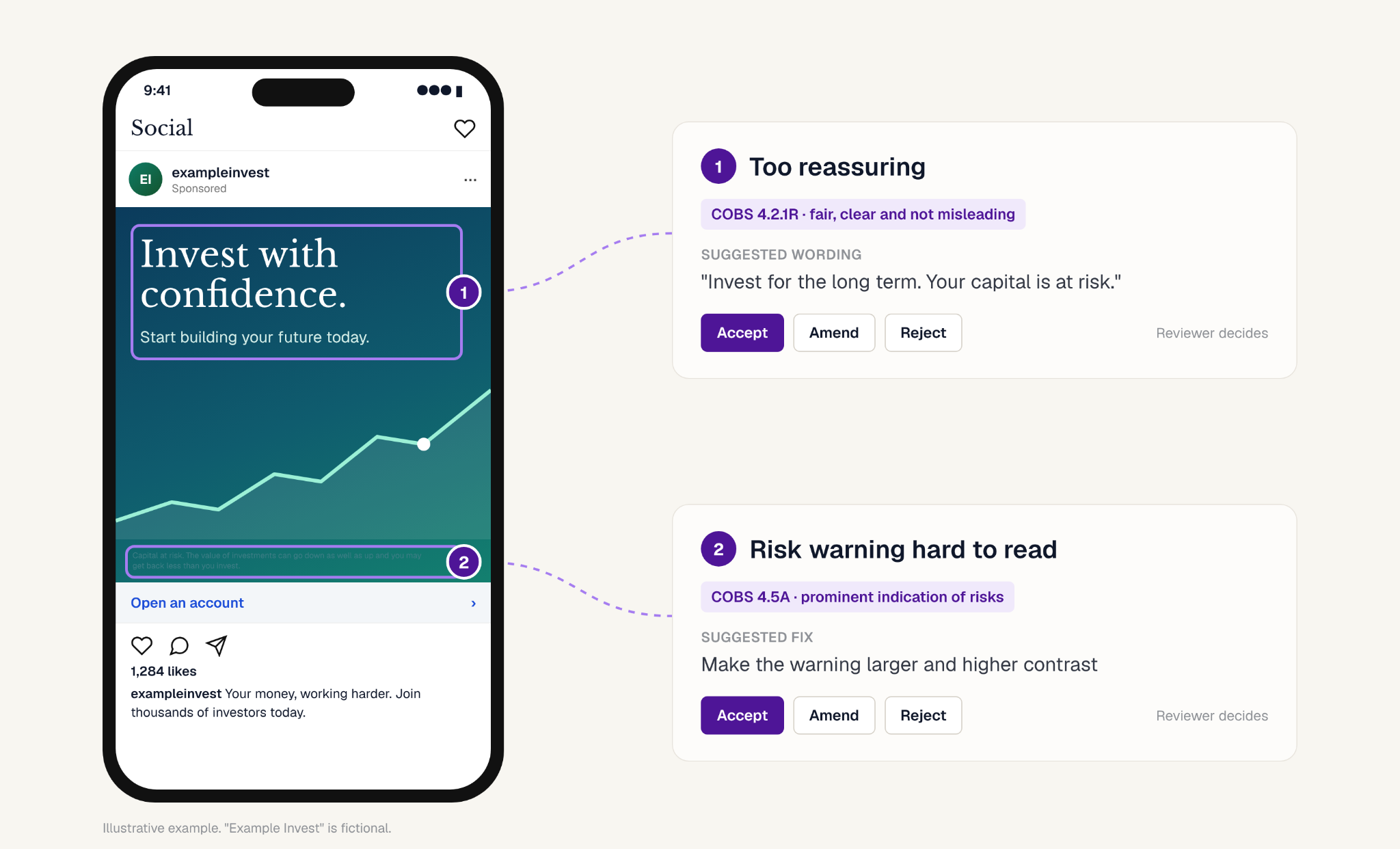
- First-pass review: when a campaign is submitted, the agent reviews each asset, drawing from the knowledge base, and raises findings. Each finding highlights the relevant text, explains the concern, cites the rule engaged with a link to the source text, and suggests a fix based on the knowledge base;
- Human decision-making: reviewers accept, edit or override each finding. The one exception is where a flagged claim matches a claim the firm has already approved: the agent marks that finding as resolved and notes why, so reviewers can see what was closed automatically. The agent never makes amendments or approves an asset, and a person must sign everything off;
- Growing the claims library: the agent detects new claims in submitted material and asks whether to add them to the library, with supporting evidence. They are only added once approved by someone with the right authority, such as the head of compliance, and can later be withdrawn, with the campaigns that used them listed;
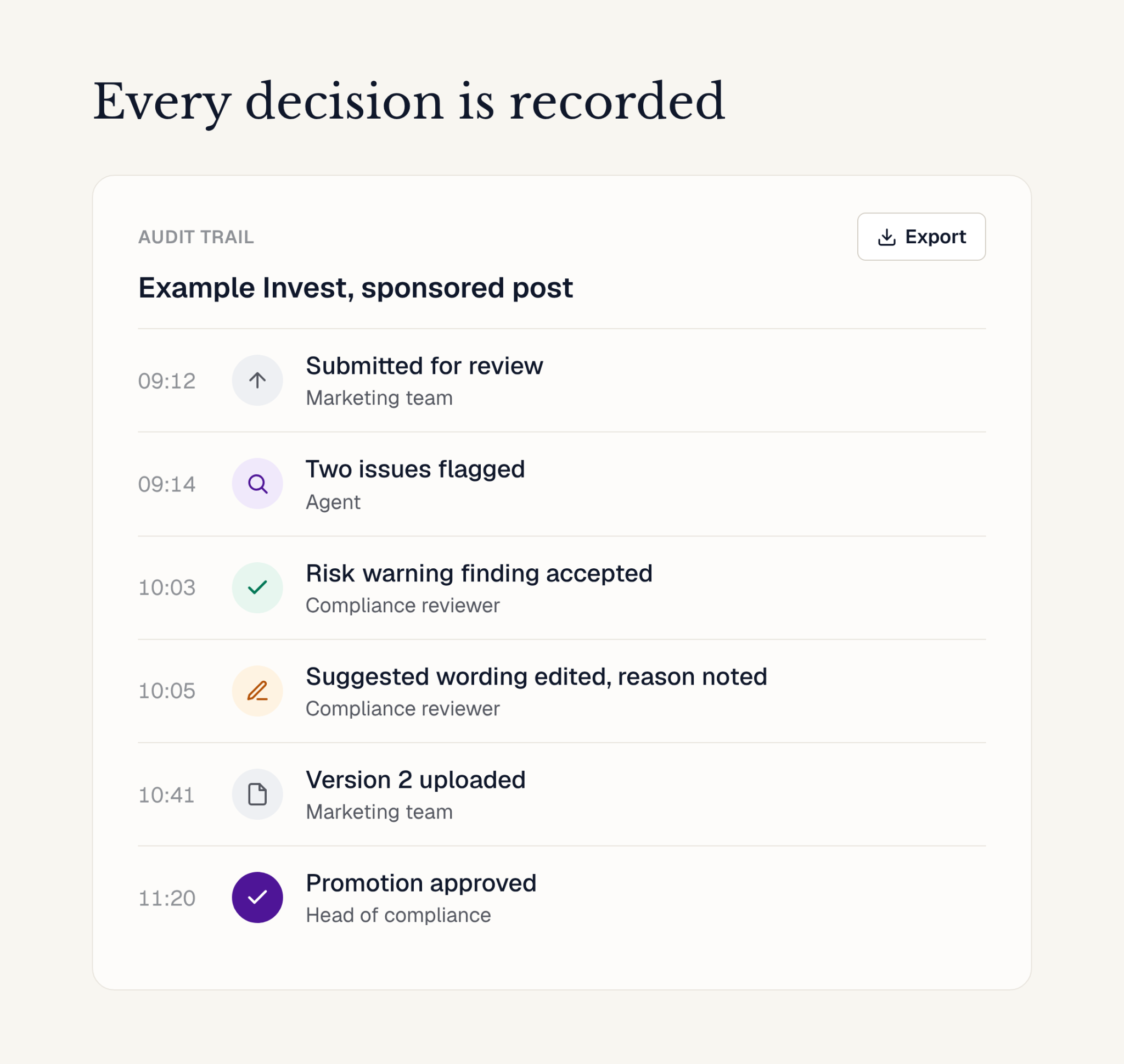
- Audit trail: every submission, finding, comment, approval and new version is logged, and can be exported as a report.
In the example below, a sponsored post for an investment app says “Invest with confidence”, with a small, low-contrast risk warning. The agent flags both issues, cites the rules and suggests fixes, but whether the promotion is compliant remains a judgement for the firm’s reviewers.
Mapping the FCA's good practice to the agent
The rest of this article works through the three areas of the FCA's publication in turn. For each one, it sets out what the FCA says, and then what this looks like in practice for the agent.
Consumer Duty and consumers in vulnerable circumstances
This area of the publication applies directly, as the material it reviews is seen by consumers. As the FCA notes, where firms deploy AI-supported tools, "they remain responsible for consumer outcomes. This includes outcomes they deliver through any products, services, communications and support."
2.1 Products and services
What the FCA says
"One smaller firm ... used carefully filtered high-quality datasets that had been reviewed by people. This helped them provide known good outputs for testing their AI systems."
"Testing outcomes across different consumer characteristics, including vulnerability and digital or financial capability, to support inclusive design."
What this looks like for the agent
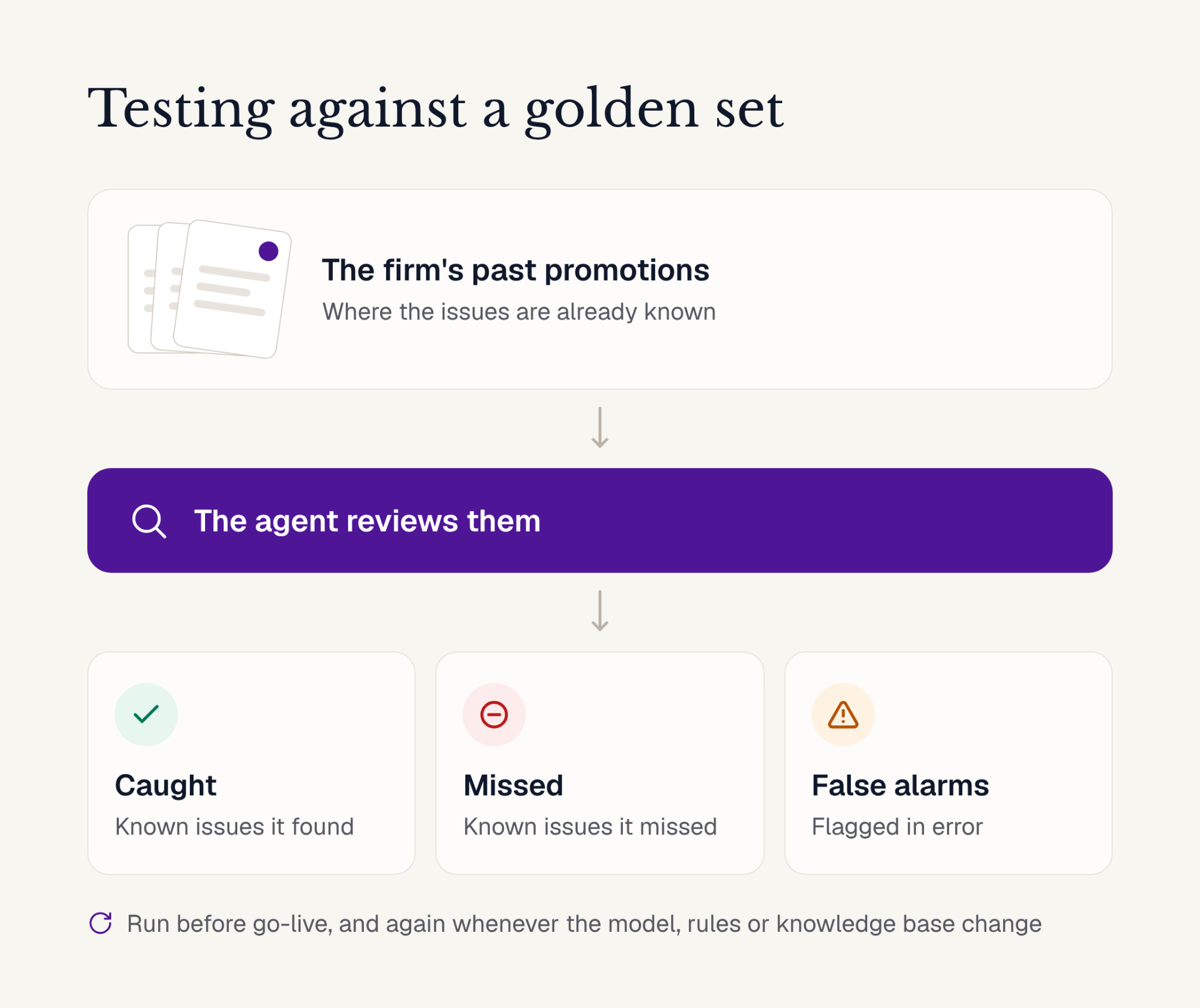
Testing against a golden set before go-live. Before go-live, firms upload a "golden set" of their own past promotions where the issues are already known. This checks that the rules and model together catch those issues, and that they do not raise ones that are not there, such as flagging a warning as missing when it is present. The set should include subtle cases, where every word is acceptable but the overall impression misleads, and a spread of languages, formats such as video, audio and text, and marketing channels, so that any uneven detection shows up. The test is rerun when the model, knowledge base or rules change.
Judging promotions against their audience. Whether a promotion is fair, clear and not misleading depends on who it is aimed at. The agent handles this through the rules: users select the target audience, such as retail customers or sophisticated investors, and only the rules that apply to that audience are run. Judging whether the wording suits that audience's level of understanding remains with the reviewer.
2.2 Consumer understanding
What the FCA says
"Using AI to make consumer communications clearer, with human review. Firms used AI to assess consumer communications and propose clearer wording. Staff reviewed all the changes before approving the final wording."
"Using approved source material and guardrails to reduce hallucinations or inappropriate responses. Firms limited chatbots and generative AI assistants to approved source material, with checks and escalation routes."
What this looks like for the agent
Much of this section concerns explaining AI use to consumers, which does not arise here because consumers never interact with the agent. However, two of the FCA's points are directly relevant.
Clearer wording, with human approval. This closely reflects how the agent works, in that it suggests clearer wording, and a person decides whether to accept, amend or reject it. The agent assesses clarity and prominence as well as content, so a risk warning that is accurate but difficult to read can still be flagged.
Suggestions grounded in the knowledge base. When the agent proposes new wording, it does so to meet the specific rule cited in the finding, so each suggestion can be checked against a requirement the firm has signed off. The wording itself is written by the model, which is why a person approves every change. This makes the quality of the knowledge base an important control in itself (see 3.1).
2.3 Consumer support and consumers in vulnerable circumstances
Where vulnerability fits. The agent does not handle consumer support or try to identify individual consumers in vulnerable circumstances, something the FCA cautions against assuming AI can do reliably. Vulnerability still matters for promotions, so firms can add rules to the knowledge base, for example on target market restrictions or plain language for products likely to reach less experienced consumers, and the agent checks every promotion against them.
Governance and accountability
3.1 Governance frameworks
What the FCA says
"Scaling oversight through existing governance. Firms, including smaller firms, incorporated AI oversight into their existing governance frameworks."
"Structured challenge, testing and sign-off before deployment. Firms took a risk-based approach to challenging their plans for new deployments. They involved staff from areas across the business in testing and sign-off."
"Retrospective governance. Firms designed and deployed AI use cases without first considering how to govern them."
What this looks like for the agent
Building on existing governance. The agent does not introduce a separate governance process. Reviews run through the firm's existing approval workflow, with routing configured to match it, such as sign-off by legal and then compliance, and each step recorded. Firms can require a second person to approve each promotion, so whoever submits it cannot also sign it off.
Governing the knowledge base. Every review depends on the knowledge base, so a missing or misdescribed rule affects every asset reviewed. Sign-off, approval of new claims and version control are the main controls, and every change is logged with who approved it and when. The knowledge base also records how each firm applies the rules where the regulator leaves room for choice. A loan advert that shows a rate or a cost figure must include a representative example, but the regulator allows a digital advert to place that example on a landing page reached through a link. One bank using the agent follows that guidance. Another requires the example in the advert itself, whatever the channel. Each knowledge base reflects its own position.
Sign-off before go-live. Section 2.1 covers what to test; the governance question is who decides the agent is ready. Compliance, marketing and the owner of the knowledge base should each review the results, with final sign-off from the senior manager responsible for financial promotions (see 3.3). The knowledge base is signed off before any material is reviewed, so governance is in place from the first campaign rather than added afterwards, which the FCA flags as "retrospective governance".
3.2 Monitoring and oversight
What the FCA says
"Forward-looking monitoring. Firms adopted monitoring approaches that tracked real-world outcomes and impacts, and adapted to evolving risks, such as model drift."
What this looks like for the agent
Tracking the agent's performance over time. Firms can rerun the golden set from 2.1 at regular intervals, not only after a change, to identify any deterioration in the agent's ability to detect known issues, and agree a threshold in advance: if the detection rate falls below it, checks increase and the issue is escalated. Regulatory change is handled through the rules: each rule lists the campaigns where it has been cited, so when a rule changes the firm can see which promotions were affected and rerun the review on them.
Tracing real-world outcomes. When a complaint or regulator query arrives about a promotion, the audit trail shows whether the agent flagged the issue and what the reviewer decided. This shows whether problems are being missed by the agent, overridden by reviewers or not covered by the knowledge base.
Learning from reviewer feedback. The FCA also lists "feedback from staff on whether they used or modified an AI output, and why" as a useful monitoring tool. Reviewers rate each finding, and a thumbs-down requires a reason, logged against the rule concerned. This shows the firm where its own interpretation differs from the agent's, and the platform learns from it: when a similar asset is reviewed later, relevant past feedback is taken into account, so the agent increasingly reflects how the firm interprets its own rules. Changes to the rules themselves are still made by people, through the knowledge base.
Dashboards and reporting. The platform's dashboard tracks the review process over time, including first-time approval rates, approval times and missed review deadlines, so a sustained change, such as a fall in first-time approvals, can be picked up and investigated. For individual campaigns, firms can export a report with each finding, the reviewer's decisions and the full audit history, for a governance committee or in response to a regulator query.
3.3 Senior management function and reasonable steps
What the FCA says
"[A] small firm emphasised the need to record whether staff ... approved the outputs, overrode them or escalated issues. This created an audit trail showing how oversight operated in practice, rather than relying on an assumed control."
"Assigning clear SMF ownership for AI risks. ... Some firms highlighted the importance of an ownership structure and tailored roles to each AI use case, rather than assigning a single owner to each model."
"Clear escalation routes. Firms had clear, evidenced escalation routes, including formal threshold-based escalation to governance bodies."
What this looks like for the agent
A complete audit trail. The audit trail described in the use case section records what the agent flagged, what each reviewer decided and which version of the knowledge base applied, giving the senior manager evidence of how oversight worked in practice, rather than assuming it.
Clear SMF ownership. The firm identifies the senior manager accountable for the financial promotions process and establishes how responsibility for the agent fits within its existing governance arrangements. A named owner for the knowledge base reports through this structure, so it is clear who is accountable for the agent's performance and who can change what it relies on.
Testing the response to a failure. Records show how decisions were made, but not whether the firm can respond when something goes wrong. Firms can test this with a dry run: suppose the agent has been missing a particular type of breach. The knowledge base owner amends the relevant rule, recent promotions for the affected products or channels are rerun, and the issue is escalated to the senior manager, who decides what to withdraw. The FCA's Case study M, where a firm agreed an incident playbook before deployment, offers a useful model.
3.4 Human oversight
What the FCA says
"Effective oversight is not simply about reviewing AI outputs, but about ensuring people have the right authority, information, capability and escalation routes to challenge or intervene where needed."
"Embedding escalation routes into AI processes. ... They set clear thresholds for when human intervention and escalation were needed, and defined how AI outputs could be challenged or overridden."
"Excessive reliance on human-in-the-loop controls. Firms relied excessively on staff to oversee AI outputs, without addressing underlying model risk or governance responsibilities. Human review may mask weaknesses in the model ..."
What this looks like for the agent
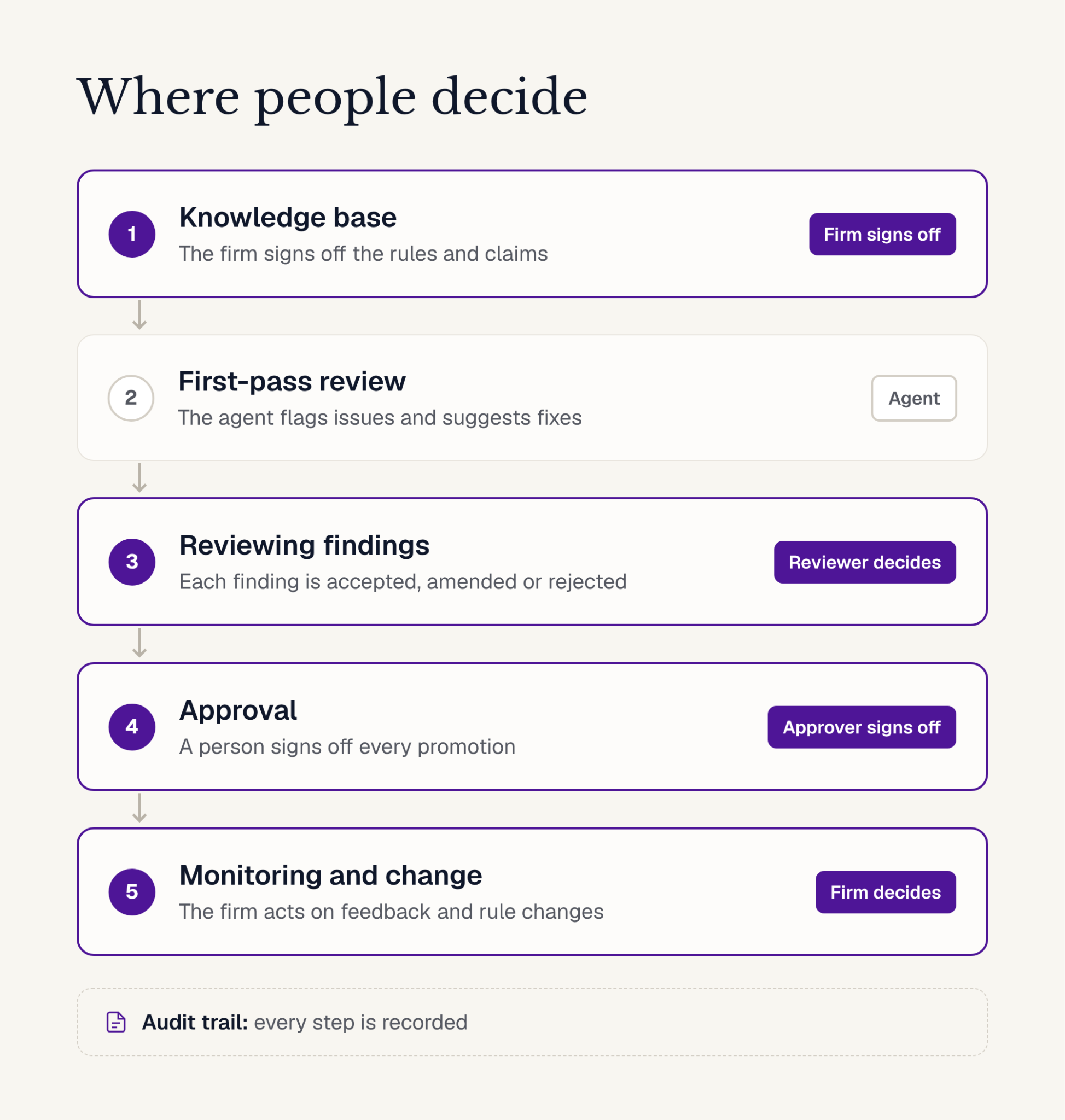
Human oversight points. A person makes the decision at each of these stages:
- Signing off the knowledge base: the firm approves the rules, claims and scope the agent works from before any material is reviewed;
- Adding claims: new claims only enter the library once approved by someone with the right authority, such as the head of compliance;
- Reviewing findings: reviewers accept, amend or reject each finding and suggested fix, and findings closed automatically because they match an approved claim are marked as such;
- Approving promotions: the agent never approves a promotion; a person signs off each one, with routing between teams configured to the firm's process;
- Responding to change: when a rule changes or a claim is withdrawn, the firm decides which live promotions to amend or withdraw; and
- Escalation: wider issues, such as the agent repeatedly missing a type of breach, go to the SMF accountable for financial promotions (see 3.3).
Giving reviewers the information to challenge. Reviewers can only challenge a finding if they can see what it is based on. Each finding cites its rule, and reviewers can click through to the source regulation to assess it for themselves rather than take the agent's reasoning on trust, which helps address concerns about explainability. Each claim in the library can also carry supporting evidence, so reviewers in marketing or compliance can see why it has or has not been approved.
Checking that reviewers still challenge. Firms can test whether reviewers still challenge by re-reviewing a sample of approved promotions and planting known breaches in the review queue, focusing on principle-based rules, where reviewers judge overall impression and are most likely to defer. Override rates alone cannot show this: a low rate could mean the agent is accurate or that reviewers are deferring to it, as in the FCA's Case study O, where reviewers "became less likely to challenge".
Technical checks alongside reviewers. Human review is not the only safeguard. Each asset is checked by multiple models and the results compared. A finding that does not appear consistently is checked again, and is removed only if it is judged to be noise; if there is any doubt, it is shown to the reviewer. Anything the agent cannot check itself is flagged for manual review, every finding is graded by severity, and the agent itself is tested separately (see 2.1 and 3.2).
3.5 Risk appetite, thresholds and oversight
What the FCA says
"Using risk appetite to guide AI development and oversight. ... We also saw firms applying risk-based approaches, using risk scoring or tiering, to calibrate their governance requirements."
What this looks like for the agent
A lower-autonomy use case. As set out in 3.4, people make every decision except closing findings that match an approved claim. Firms can factor this into how they tier the use case against their risk appetite, alongside the consumer impact of the promotions it reviews. Within those limits, each firm sets its own appetite through the rules in its knowledge base and how it structures sign-off.
Operational resilience
4.1 Operational and cyber resilience
Continuity if the agent is unavailable. This section focuses on keeping important business services running if an AI system changes, degrades or becomes unavailable. The agent uses multiple models, hosted across several European regions so that data stays in Europe, and an outage in one region need not stop reviews. Firms should also consider how reviews would continue if the platform were unavailable altogether, including whether they could temporarily revert to manual review. This should form part of the firm's wider business continuity and third-party risk management arrangements.
4.2 Third-party relationships
What the FCA says
"Firms can outsource AI services, but remain responsible for them."
What this looks like for the agent
Keeping accountability with the firm. The firm remains accountable for every promotion it approves, so it needs to be able to check the agent itself. Firms test the agent on their own golden set (see 2.1), and Zango tells clients about significant model changes so they can rerun it. Zango also keeps the regulatory rules in the knowledge base up to date as regulation changes.
Building an evidence base for good practice
Applying the FCA's observations to a single deployment shows just how context-specific effective AI governance is. The appropriate controls depend on the use case, the risks involved, the level of autonomy and the processes within which the AI operates. What works for a marketing compliance agent will not necessarily work for an agent handling customer complaints or conducting enhanced due diligence.
This makes it particularly important to move beyond general principles and examine what good governance looks like for individual deployments. This means considering how controls are designed, how they operate in practice, and what evidence demonstrates their effectiveness.
As the technology and regulatory expectations continue to evolve, there is considerable value in financial institutions sharing these experiences, comparing approaches and collectively developing a clearer understanding of what good practice looks like in different contexts.
For more on how financial institutions are approaching AI governance, read our report, The Future of AI Governance & Compliance in Financial Services.


